Homepage defacement
Example Municipality A


PULSHEX / CYBER INCIDENT INTELLIGENCE
PULSHEX detects public reports of cyber incidents affecting Greece, assesses the available evidence and correlates information from different sources. Each record comes with supporting evidence and, where sufficient information exists, a separate analysis of impact and recommended protective measures.
01Live feed
Checking whether your subscription is active on this device…
FROM 65€ / YEAR — NO ACCOUNT
01 / SOURCE INTELLIGENCE
Public announcements and publications about ransomware, data leaks, account compromise and other documented cyber incidents. Collection covers selected accessible sources, not inspections of organisations’ systems. Listing a source does not mean active coverage and does not guarantee detection of every incident.
Official public announcements from selected municipalities and regions. Listing an organisation does not in itself mean active monitoring.
Public announcements from organisations, businesses and competent authorities. Official confirmation requires an explicit reference to the specific incident.
Selected news, financial and local media. Republications of the same original information are not considered independent confirmations.
Specialist and international public publications concerning organisations or infrastructure. Unverified claims are not confirmed incidents.
An outage, a vulnerability announcement or an unverified claim is not enough to record a cyber incident. Public Threat Map telemetry is separate from the incident feed.
02 / INCIDENT INTELLIGENCE
Public sources, a unified record and analysis with clear limits of certainty.
The Intelligence Engine is the PULSHEX mechanism that creates original, documented records from facts verified in public sources: it identifies organisations and incidents, correlates sources, checks provenance and avoids duplicate records.
MONITOR / 01
Collection of public publications from selected sources. Listing an organisation does not equate to active coverage.
Public reports → collection
Each incident page separates source evidence from the PULSHEX analytical assessment. Where a completed analysis is available, it includes known and unknown information, the level of certainty, documented and potential impacts, a timeline, recommended measures and a PULSHEX Security Takeaway.
The recommendations are general resilience measures. They do not imply that the organisation lacked them or that they would necessarily have prevented the incident. Historical records may not yet have a completed analysis.
SIGNAL ANALYST
See how PULSHEX turns information from public sources into organised cybersecurity knowledge.
The character on standby.
Illustrative presentation of the process; no analysis runs during your visit.

BROWSER INTELLIGENCE
 PULSHEX Browser Intelligence
Discover documented cybersecurity incidents related to the websites you visit, directly from Google Chrome.
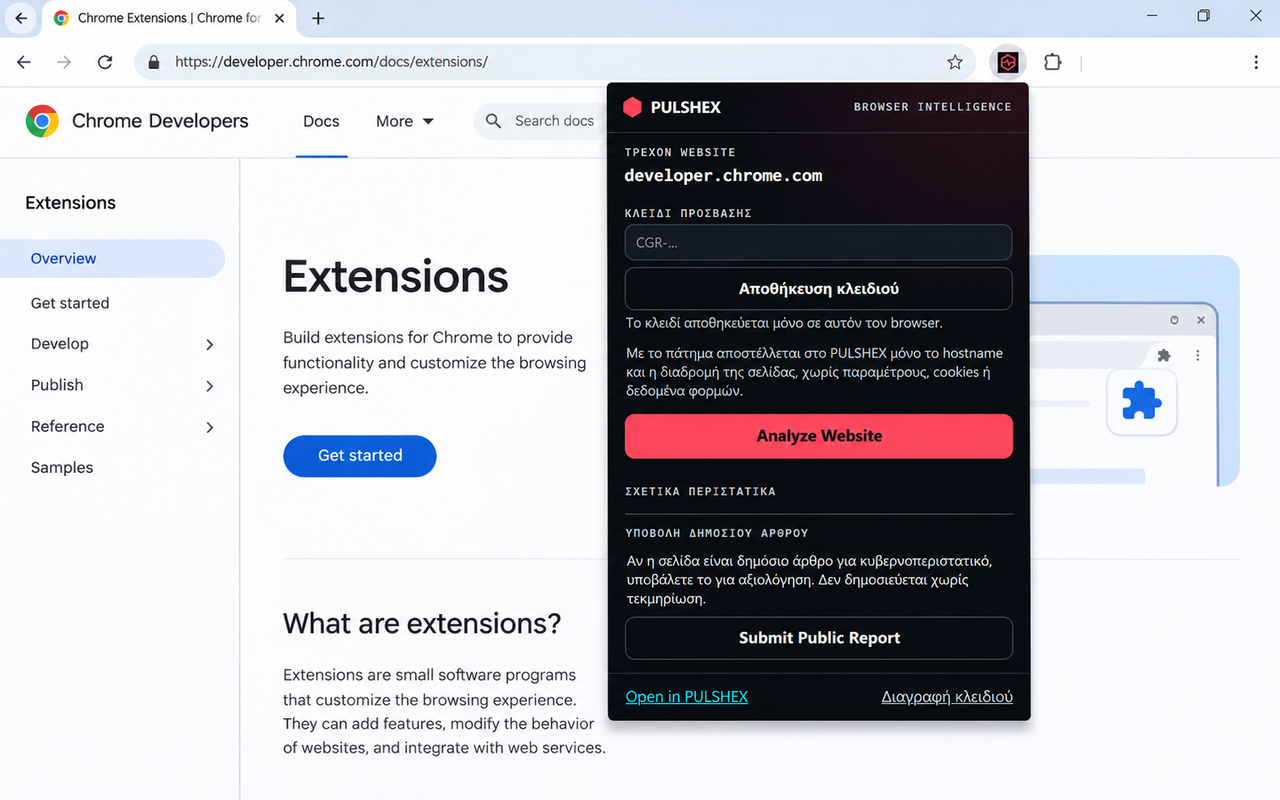
// CASE FILES
Real, publicly documented incidents — to help you understand each type of attack.
Attackers lock an organisation’s files and demand a ransom to unlock them.
DOCUMENTED INCIDENT
Municipality of Thessaloniki: files on the internal network were encrypted. The municipality had backups and did not negotiate.
Source: Kathimerini
Thousands of simultaneous requests overwhelm a website to take it offline.
DOCUMENTED INCIDENT
Question Bank: a two-day attack caused delays in national examinations.
Source: The Record
Attackers gain access and extract documents or personal data.
DOCUMENTED INCIDENT
Hellenic Cadastre: following 400+ attacks, around 1.2 GB of administrative documents were extracted.
Source: Hellenic Cadastre
Access using stolen user passwords, without breaking into a system.
DOCUMENTED INCIDENT
Municipality of Patras: a third party downloaded documents using user credentials. The municipality enabled 2FA.
Source: Municipal announcement (via SKAI)
// FOR BUSINESSES
In development: the Business Website Exposure Assessment is not currently included in any subscription plan. It will concern only the business website/domain, never natural persons, and will be based on the website’s public information and incident relevance, without access to internal systems.
Optionally enter your website and give consent on the purchase form.
Once activated, processing reviews the public content of the business website. No analysis takes place before purchase.
It will show incident relevance for the website/domain — not a likelihood of a breach, an audit or a guarantee of security.
Updates link each incident to the business’s sector and services and to general resilience guidance.
Once completed, the assessment will concern only the business website/domain provided by the business, never natural persons, and will be based on the website’s public content and the relevance of documented incidents. It will not be a scan, a security audit or a guarantee of security. PULSHEX does not use AI for profiling, scoring or decision-making about natural persons. AI provides informational analysis to help understand cybersecurity risks to organisations.
The Business Website Exposure Assessment is in development and is not currently included in any subscription plan. Processing is not active and providing a website does not start any analysis.
View the Full plan